
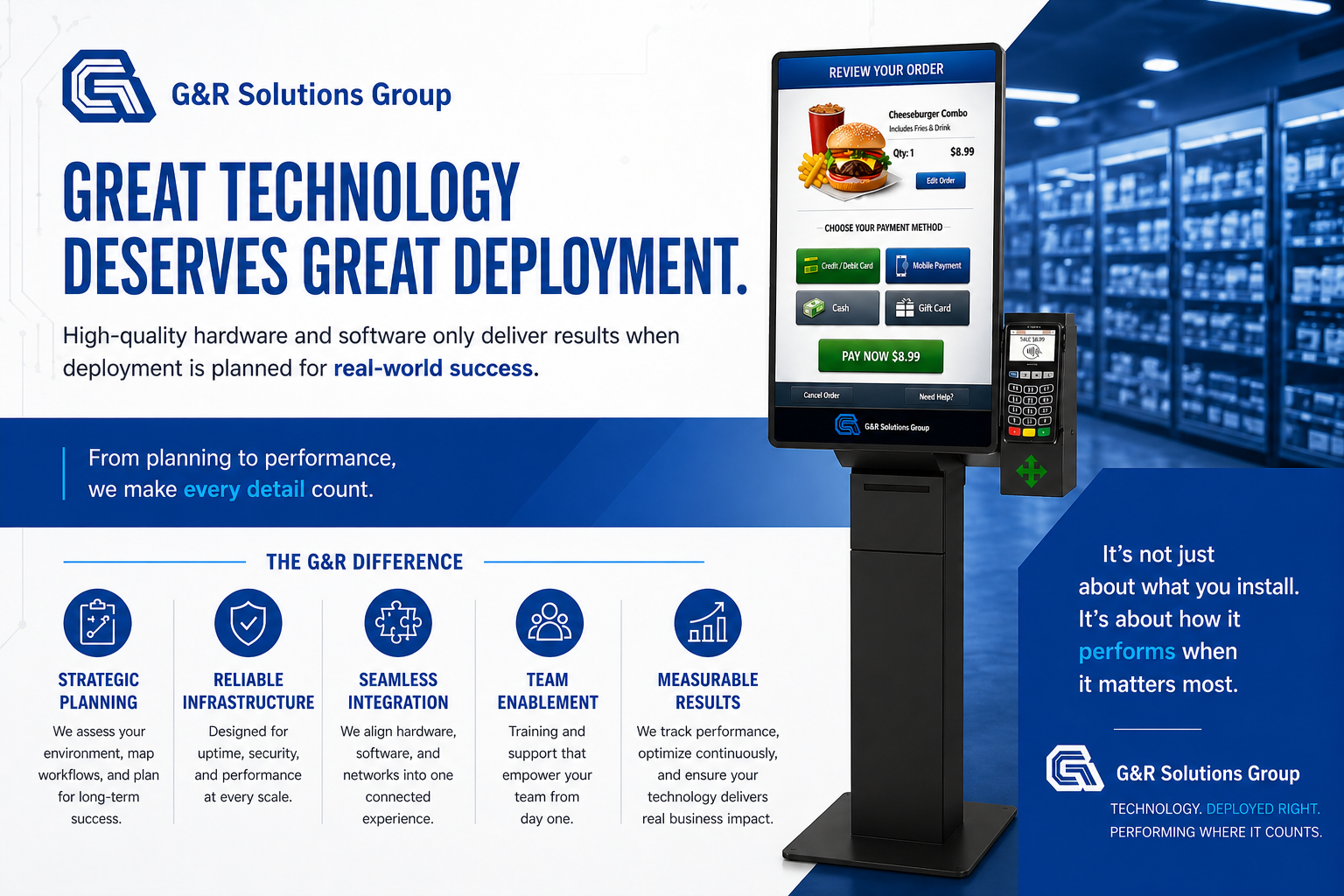
The biggest risk to your technology investment isn’t the hardware. It is how you deploy it.
At G&R Solutions Group, we’ve seen high performance kiosks, enterprise grade infrastructure, and powerful software stacks fall short not because the technology wasn’t right, but because the deployment strategy was not.
In modern enterprise environments the success of any technology initiative depends less on the specifications of the system and more on how it is implemented, integrated, and operated in real world conditions. Even the most advanced solutions can fail when deployment is treated as an afterthought instead of a structured process.
Where poor deployment planning shows up
When technology fails in production environments it is rarely a hardware issue. It is almost always a deployment and execution issue.
Common problems include:
• Hardware placed without understanding real customer flow or operational behavior
• Networks not engineered for peak traffic, redundancy, and long term scalability
• Systems installed without aligning to daily operational workflows
• Software and hardware integrated without full end to end system alignment
• Teams left without proper training, documentation, or ongoing support
• Rollouts executed without real world stress testing or usage validation
Everything looks solid on paper. Execution tells a completely different story.
Technology is not plug and play
A common mistake in digital transformation projects is assuming that technology will perform immediately once installed.
In reality, enterprise systems such as kiosks, digital infrastructure, and software platforms must be carefully integrated into the business environment.
This requires:
• Alignment with real operational workflows
• Integration across hardware, software, and network layers
• Stress testing under real usage conditions
• Continuous monitoring after deployment
• Clear ownership and support structures
Without these elements even best in class technology becomes an underutilized investment that fails to deliver expected outcomes.
Why deployment strategy determines success
This is where G&R Solutions Group focuses differently.
We treat deployment as the foundation of performance rather than the final step of implementation.
A strong deployment strategy ensures that technology is not just installed but fully operational, optimized, and aligned with business goals.
Our approach includes:
• Mapping infrastructure to real world usage patterns and scalability requirements
• Designing network architecture that ensures uptime, security, and growth readiness
• Aligning hardware, software, and workflows into a unified system
• Validating performance through real environment testing before full rollout
• Training teams to operate, manage, and support systems effectively from day one
• Building scalable deployment models that evolve with business needs
This transforms deployment from a technical process into a business performance driver.
The hidden cost of poor deployment
Poor deployment does not always show immediate failure. In many cases systems appear functional while underperforming silently.
Common hidden costs include:
• Reduced system efficiency under real workload conditions
• Low user adoption and engagement
• Increased operational friction across teams
• Higher long term maintenance and support costs
• Failure to achieve expected return on investment
These issues often go unnoticed until the system is fully in production and difficult to correct.
Success is defined after launch
Technology success is not measured at installation. It is measured after deployment when the system is actively in use.
Key indicators of success include:
Does the system scale under real demand
Does it integrate seamlessly into daily operations
Does it reduce friction instead of creating it
Does it improve efficiency in real environments
If the answer is yes then the deployment strategy was correct. If not then the issue is not the technology but the implementation.
Before your next rollout ask this
Before deploying your next kiosk system, software platform, or infrastructure solution ask yourself:
Are you deploying a fully integrated solution
or are you simply placing equipment and hoping it performs
Because in modern enterprise technology environments execution is the product and deployment is where success is either built or lost.